

While bro science has preached it for years, it seems like self-experimentation is picking up more steam in 2026, and for good reason.
It’s generally useful to use empirical evidence to guide health decisions, but self-experiments allow you to find what works for your physiology, WHICH IS THE WHOLE POINT.
It forces you to stop outsourcing your thinking. You stop doing things because “Huberman said it’s good for me” and start engaging critically with your behaviors, building body awareness, and weeding through the BS yourself.
You start acting less like a mindless consumer and more like a sovereign scientist.
Don’t believe circadian rhythm is the foundation of health? Excellent. TRY IT and see for yourself.
And for those who say n=1 isn’t “good science,” that couldn’t be further from the truth. Self-testing done right is controlled, thoughtful, and tracked. Chris Masterjohn just posted a great conversation on this.
That said, here’s how you can successfully run your own n=1 experiments to optimize your health and performance.
Set-Up
One change at a time: If you’re manipulating multiple variables at once, there’s no way to tell what’s helping and what’s hurting. Focus on one variable at a time and keep every other element of your lifestyle as consistent as possible.
Form a hypothesis, but stay objective: There should be some intention behind what you’re trying rather than “I’m just doing it to see what happens.” You should also be prepared and open-minded to a result you’re not expecting. Your n=1 will often be vastly different than someone else’s.
Long enough timeframe: The body often changes slowly. I’ll be running 30-day experiments but the truth is you may need a longer timeframe of 2-3 months before you start seeing anything meaningful in the data. Don’t stop too soon before the magics starts to happen.
Plan ahead: Make sure life doesn’t get in the way ahead of time. Maybe that means meal prepping, communicating with loved ones, making sure supplements are ordered, etc.
Follow through: This ties in with the long timeframe. If you’re making meaningful changes, it’ll probably feel uncomfortable at times. Stay the course and log whatever you’re feeling as a datapoint. Ex: “Really strong cravings for sweets on day 7”
Tracking
Tracking your data is the key to stopping the guesswork and getting objective conclusions from your experiments. Ideally, you’re tracking over various time horizons:
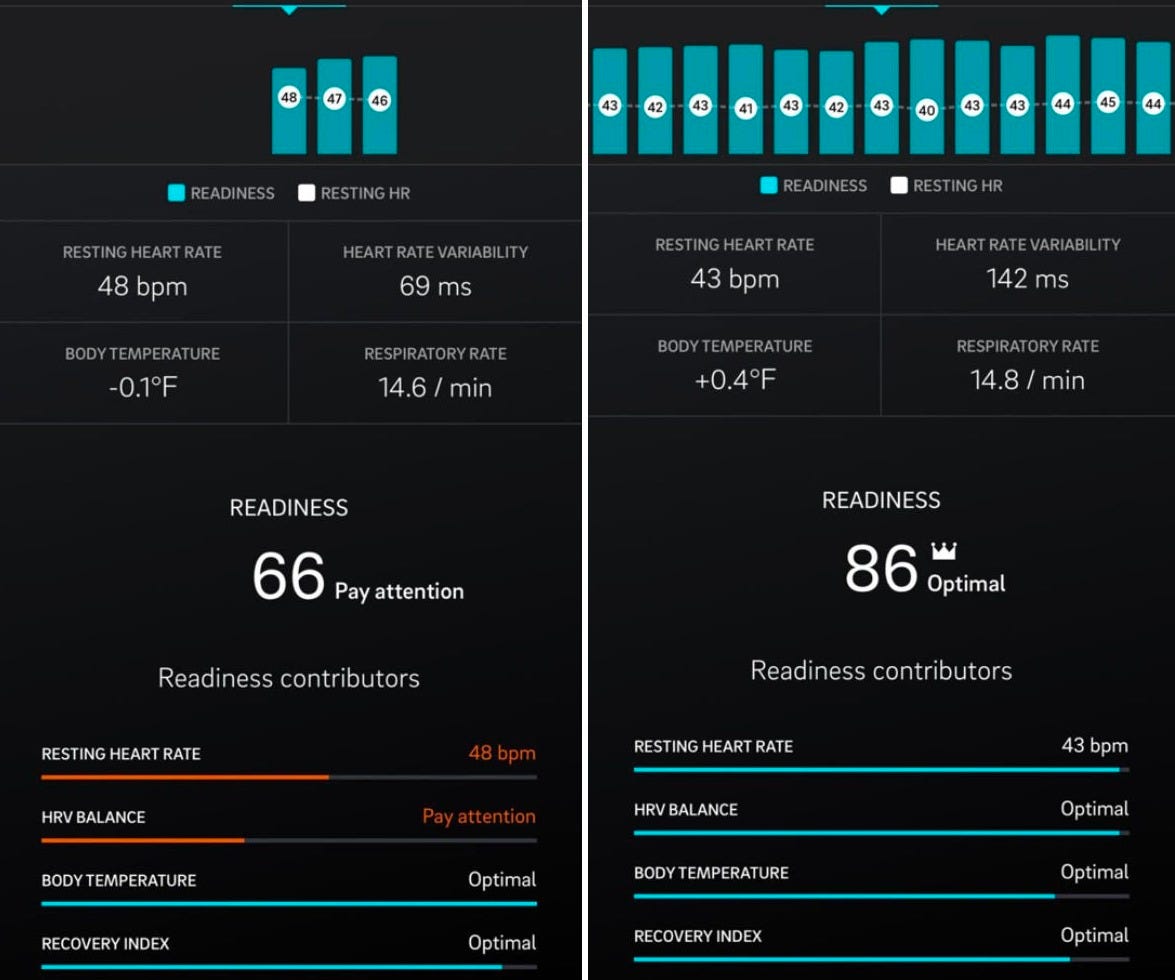
Real-time tracking with wearables: Oura and WHOOP are helpful for metrics like HRV, resting heart rate, sleep quality, and menstrual cycle. A CGM offers insight into real-time blood glucose response from specific lifestyle interventions (food types, meal/exercise timing, sunlight exposure, etc.).
Daily/Intra-daily tracking: Use a KetoMojo to test glucose and ketone levels strategically throughout the day (ex: first thing after waking, one hour after eating). Chris Masterjohn also advocates tracking lactate for additional metabolic health insights, though this is more expensive. It’s also worthwhile to log daily food intake in Cronometer to ensure you’re staying consistent and/or hitting the desired macros and nutrient intake.
Longer-term tracking: Get labs done to assess progress over a longer time horizon (1+ month). Bloodwork is most common and cost-friendly, but you may also choose a GI map, organic acids test, or hair tissue mineral analysis depending on the desired metrics and outcomes. Use Own Your Labs if you’re looking for specific blood tests or a service like Function for comprehensive year-long testing.
Qualitative tracking: I highly recommend journaling daily to log subjective effects of the interventions you’re running. This will add color to all the quantitative metrics you’re tracking and really start to build body awareness. Timestamp what day/time you’re on and whatever emotions, physical sensations (pain, drowsiness, etc.), cravings, thoughts, and anything else meaningful that arises.
My 2026 Self-Experiment Lineup
Now that you have the framework, here are some n=1’s I plan on running on myself in 2026. The timeframe for most of these will be 30 days with before/after bloodwork based on the intervention and finances. May also dust off the old Oura ring if it’s still functional.
Skipping dinner (starting next week)
Nutrient maxing - thiamine, magnesium, potassium, etc.
60+ minutes per day of prayer and silence
Grounded to the earth 24/7
Eating strictly raw honey
Testosterone maxing with Tom Seager’s cold + exercise protocol
DHT maxing with topical androsterone + DHEA + pregnenolone
What else would you like to see?