

Modern man has forgotten what true productivity is like. Deep focus and output should be the baseline, but today we’re more distracted than ever and our physiology is depleted to the point that even simple work feels like a struggle.
Elite productivity takes intention in the modern world. If you want to get an insane amount of work done in less time and with less challenge, it comes down to four pillars: health, environment, focus, and process.
Good Health Lays the Foundation
“…to perform your best…and truly reach and sustain your performance potential, you need to be a healthy person first.” - Peak, Dr. Marc Bubbs
A solid foundation of health is required for any performance discipline, especially focus, creativity, and productivity. You can’t put out your best work if your physiology leaves you foggy and low energy. Make sure you’re consistently dialing in the health fundamentals:
Sleep quality: non-negotiable for daytime output and alertness
Circadian rhythm: alertness and energy production during the day and restoration at night
Nature: mitigates mental fatigue, stress accumulation, and mitochondrial function
Blood sugar: spikes and crashes cause brain fog and lapses in focus
Gut health: Pathogenic overgrowth drives neuroinflammation, brain fog, and energy lapses
Stress management: Keeping the nervous system regulated and building resilience is essential for getting work done
EMF mitigation: Reduce exposure where possible, especially in your work space and while you sleep
Oxygen delivery: Posture, mobility, breathwork, and sunlight/grounding are essential for delivery and utilization of oxygen in the mitochondria
Work Environment Optimization
Your workspace either enables focus or destroys it. The standard office cubicle is a classic example of how not to design your workspace for productivity. No access to the outdoors or windows. Flickering blue-dominant lighting overhead. Ambient noise and impromptu “pop-ins”…
The most ideal work setup would be outdoors in a relatively secluded area. The direct & indirect sunlight, brightness, fresh air, and grounding set the physiology for optimal productivity without burning out the system.
Now, obviously that’s not practical for most, but use that as a framework to strive for with your indoor workspace:
Optimize lighting using a Chroma Sky Portal for brightness and NIRA or incandescent light bulbs for infrared light, reducing sympathetic load from flicker, and supporting retinal health
A reptile bulb can be used periodically to supplement UV light while you’re working
Use Iris software on your screens to minimize the blue light spike and open windows whenever possible to balance out the spectrum and get fresh air
A grounding mat, ideally plugged directly into the earth and fed through a window, reduces neuroinflammation and increases energy output in the brain while working
Prioritize getting outside and moving your body on your breaks
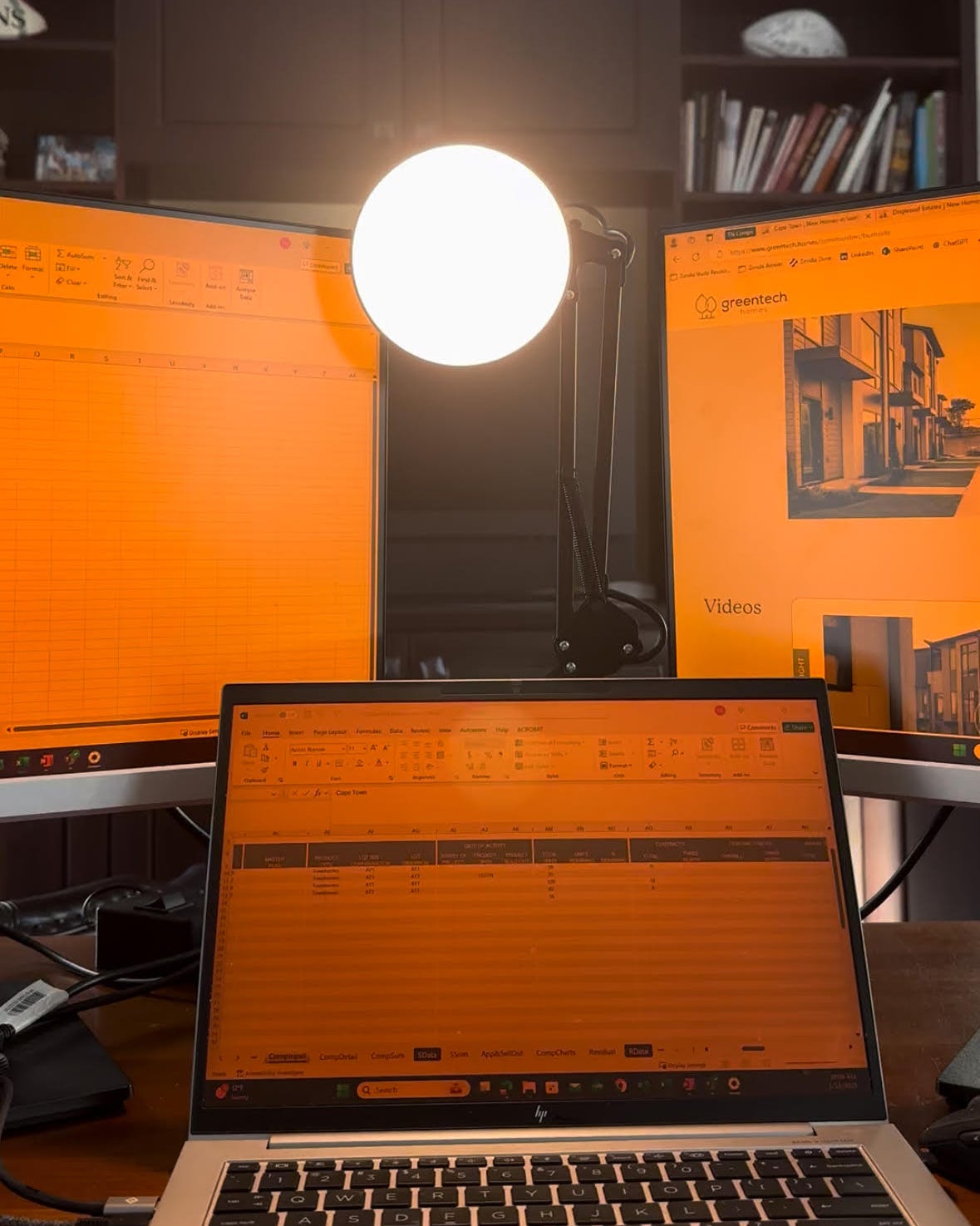
Additionally:
Minimize distractions: situate your desk to face a wall, keep your phone out of the room, silence notifications on your computer, and use noise-cancelling corded headphones and daytime blue light blockers if necessary
Declutter: a clean workspace reduces cognitive load and distractibility
Workflow Planning & Process
Productivity is as much about efficient work as it is about hard work. You need a consistent, clearly defined process for how you’re going to get sh*t done amidst a busy lifestyle and competing interests.
Set long-term goals: what do you want to achieve three years from today?
Break down the time horizon: You have your three-year target. Where do you need to be in one year, six months, three months, one month, one week from now to stay on track?
Turn goals into daily actions: Winners and losers both set goals, but those who succeed are action-oriented, not outcome-oriented. If you want to supercharge your productivity, you need clearly defined daily actions to check off (pro tip: physically writing them down and checking them off engages the reward tract in the brain, increasing dopamine).
Time-blocking: It’s not enough to have a to-do list. You need to map daily actions to a specific time of day that you’ll accomplish them. Make sure you block off enough time for the task and treat that time as sacred. No interruptions or reschedules.
Eliminate busy work: Focus only on what moves the needle, eradicate everything else during your work blocks.
Minimize distractions: Get off your phone, close out unnecessary tabs, turn off non-essential notifications, reduce physical and digital clutter, communicate with your people that you’re not to be interrupted.
Use tools wisely: AI can speed up learning, synthesizing information, and organizing ideas (use it wisely - don’t outsource your brain). Pen and paper are useful for focus, retention, and reducing mental load. A Daylight Computer gives you the analog benefits of pen & paper with all the capabilities of a laptop (I plan on getting my hands on one soon).
Rebuild Focus & Supercharge with Nootropics
