

Have you noticed how out of control the sexual dysfunction market has become? Erectile dysfunction (ED) and premature ejaculation (PE) ads are everywhere and they’re increasingly targeting younger men, boasting “discreet packaging” to avoid shame and embarrassment.
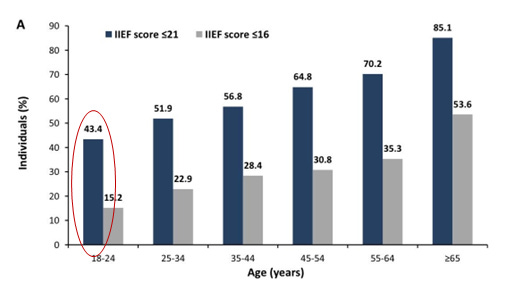
In this study, over 40% of men under 25 report some degree of erectile dysfunction, with suboptimal sexual function creeping into younger and younger age groups.
It’s not just a “mental block” causing the performance issue. At its core, sexual dysfunction is a dopamine problem.
Dopamine and Sexual Performance
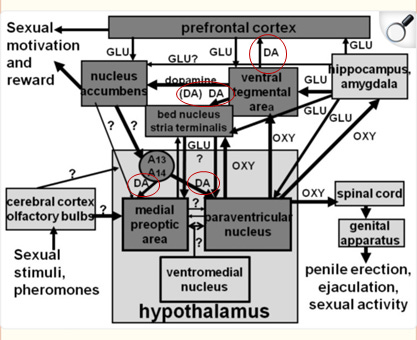
Sex is supposed to be one of the most dopaminergic experiences we have. Proper sexual arousal, erection, copulation, and ejaculation timing all depend on optimal dopamine signaling in the brain’s reward pathway. Glutamate and oxytocin play a role here as well, but these neurotransmitters are also governed upstream by dopamine.
Erectile Dysfunction
Erection quality relies on proper sexual arousal to trigger penile blood flow. When dopamine becomes depleted in the reward pathway and the prefrontal cortex, arousal is harder to achieve. Alternatively, you can feel aroused but the brain doesn’t relay the proper downstream signals through the PVN, such as oxytocin and nitric oxide, that trigger erection.
Premature Ejaculation
In a low-dopamine state, the brain constantly seeks cheap reward signals, orgasm being one of them. The nucleus accumbens speeds up ejaculation timing, while insufficient D2/D4 (the inhibitory dopamine receptors) and GABA activity can’t “put the brakes” on, lowering sexual stamina.
Research shows that restoring dopamine activity by administering D4 receptor agonists, like apomorphine, improves sexual function in rats, highlighting just how central dopamine is to the whole process.
The Dopamine-Prolactin Axis
Low dopamine also perpetuates sexual dysfunction via the dopamine-prolactin feedback loop.
Dopamine regulates prolactin in the pituitary.
Prolactin literally means “for lactation.” Its evolutionary purpose is to suppress sex hormones in favor of lactation. In men, it increases bonding towards mates and children.
Prolactin lowers the gonadotropins (LH and FSH) via the hypothalamic-pituitary-gonadal axis. The gonadotropins are what trigger sex hormone production in the reproductive organs.
For men, this means lower testosterone and DHT, key drivers of sexual function and masculinity.
Evidence supports this connection: men taking 5-alpha reductase inhibitors for hair loss, which lower DHT, reported a 212% increase in sexual dysfunction.
The Vicious Cycle
Sexual performance issues can destroy a man’s confidence. Shame and loneliness can push you to withdraw and seek comfort in more dopamine-depleting habits like porn, social media, or gaming. This only worsens the deficit and further engrains the dysfunction. Overcoming the shame and getting your headspace right are just as important as your physiology when it comes to sexual health.
The Takeaway
There’s no Viagra in nature. If a species’ physiology is so weak that it can’t reproduce, it goes extinct.
Sexual performance is a tell-tale sign of dopamine status, but the implications go far beyond that. Building a resilient human race, one that can think freely, live free of medication and centralized control, and act independently starts with healthy dopamine signaling.
If you’re dealing with ED or PE, use the dopamine restoration protocol to get your brain back. Don’t let shame push you further into loneliness and bad habits.
I struggled silently for years before getting my physiology back online and mustering the courage to seek relationships. You’re definitely not alone - men usually just don’t want to admit it. Prioritize grace and patience.