The modern athlete, whether performance- or physique-focused, must strike a balance between time in the gym and time in the sun.
Not only does sunlight exposure elevate every dimension of your health, but the pharmacy of byproducts produced through sun exposure have shown impressive effects on preserving muscle size and function.
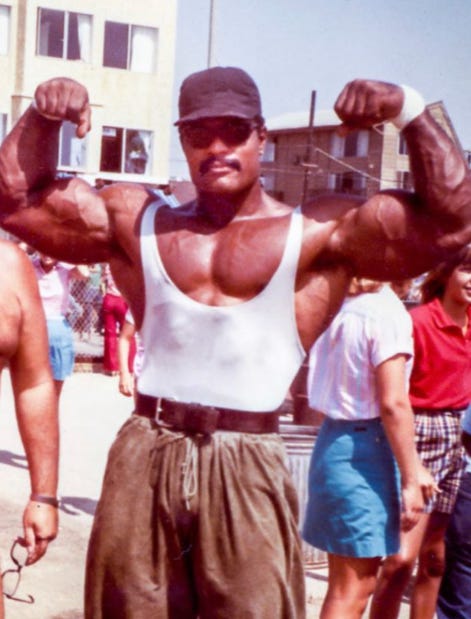
The issue with gym-centric bodybuilding is it packs on metabolically compromised muscle, driven by artificial blue light and nnEMF paired with a lack of sun exposure.
The massive amounts of muscle demand a high amount of energy while suboptimal mitochondria within the muscle drives oxidative stress and aging. This is why bodybuilders don’t live long.
On the other hand, every wavelength of light from the sun works in synergy to enhance muscular health and function, benefitting athletic performance, physique, and metabolic health. Benefits below:
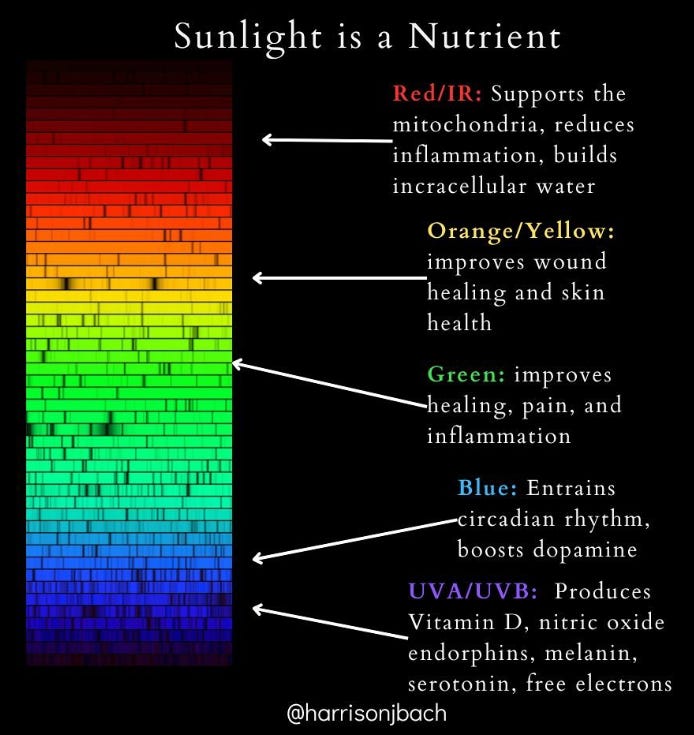
Red & Infrared Light
It’s long been known that red light therapy on muscle tissue enhances athletic performance. The central mechanism at play is energy production in the mitochondria.
The mitochondria absorb red and infrared light wavelengths, upregulating cellular energy production (ATP) in every cell it touches, including muscle cells. This enhances muscular output and recovery while slowing fatigue onset.
Because of the upregulated energy factory, muscle cells absorb significant amounts of blood glucose when exposed to red/IR light, supporting muscle preservation.
Red/IR also reaches the mitochondria in nerve cells, enhancing contractile function of muscle for faster reaction times and greater power output.
Red light doesn’t just enhance ATP production. It also produces:
Subcellular melatonin: A potent antioxidant that scavenges free radicals and preserves bioenergetics in muscle cells.
Metabolic water: Holds charge within cells and preserves electrical gradients across cell membranes and on surfaces throughout the body. Intracellular water content within lean mass is directly correlated with muscular function, strength, and speed of breakdown.
With a more efficient electron transport chain, there’s less electron leakage in the mitochondria, lowering oxidative stress and preserving muscular homeostasis.
Red and infrared light form the “base” of sunlight, akin to Zone 2 acting as the “aerobic base” for cardiovascular training. Sunlight is 50-80% red/IR all times of day. Soak it in.
Visible & UV Light
In the visible spectrum (ROYGBIV), blue light actually plays an important role in muscular function. While artificial blue light in isolation is harmful, blue light in the context of the sun’s full spectrum increases sympathetic drive, dopamine, and circulating blood sugar and catecholamines, all of which are crucial signals for maximal physical output during training.
Within the ultraviolet spectrum is UVA and UVB light. UVA exposure enhances dopamine through the photo-excitation of tyrosine. But perhaps UVA light’s most important role for muscle is increasing blood flow.
UVA exposure drives the release of nitric oxide from skin cells. Nitric oxide is a known performance enhancer. Enhanced blood flow means more oxygen and energy substrates carried to the muscle and nervous system. You’ll be hard-pressed to fine a gains-maxxer that’s not using some sort of NO enhancer. UVA does it for free.
UVB light is just as impressive. Vitamin D, synthesized in response to UVB on the skin, enhances muscle function by reducing oxidative stress in muscle tissue.
UVB also interacts with the POMC molecule to produce a pharmacy of performance-enhancing peptides. These include:
Alpha-MSH: a-MSH increases glucose uptake in muscle. It’s been shown to directly decrease muscle wasting when administered to older populations. Alpha-MSH is a truly insane molecule for physique…it reduces appetite, increases energy expenditure, and preserves muscle all at the same time. I wrote a love letter to a-MSH here.
Beta-endorphin: In addition to its mood-enhancing and pain-killing effects, b-END decreases muscular fatigue, increases muscle glucose uptake, and improves overall muscular output.
Melanin: Produced via a-MSH (“MSH” stands for “melanocyte-stimulating hormone”). Melanin is one of the most complex molecules in the human body. In the context of muscle, melanin quenches DNA-damaging free radicals and transduces electrical signals in nerve cells. It also enhances dopamine signaling while counteracting neurotoxins.
UV light doesn’t enter the atmosphere until 60-90 minutes after sunrise. Use MyCircadian to check for your location.
DON’T FORGET DARKNESS AT NIGHT!
Sunlight is only effective in the circadian context, which means bright sunlight during the day and near-total darkness at night.
Constant light exposure into night hours speeds up muscle wasting. Artificial light at night (ALAN) modulates the POMC molecule to increase catecholamines and blood glucose around the clock, a constant metabolic stress that contributes diminished muscle mass and function.
Even a small amount of ALAN suppresses melatonin and affects POMC. If you haven’t optimized your nighttime lighting by now, check out my IG.
Final Thoughts
You don’t need to stop working out. But if you live in the gym, you’re missing out on gains if you’re not balancing out training time with sun time. Make sure you’re getting sufficient exposure in the key windows:
Sunrise and sunset are free red-light therapy. UV isn’t available during this time.
UVA enters 60-90 minutes after sunrise and leaves 60-90 minutes before sunset.
UVB depends on your season and location, typically strongest from 10a-2p. UVB is unavailable in northern latitudes in the winter.
The sunlight rabbit hole led me to move virtually all of my training to an outdoor setting. Of course, you’re sacrificing some gains with this approach, but it’s generally been easy for me to achieve strength and hypertrophy gains despite a minimalist approach that’s largely calisthenics-driven.